Press
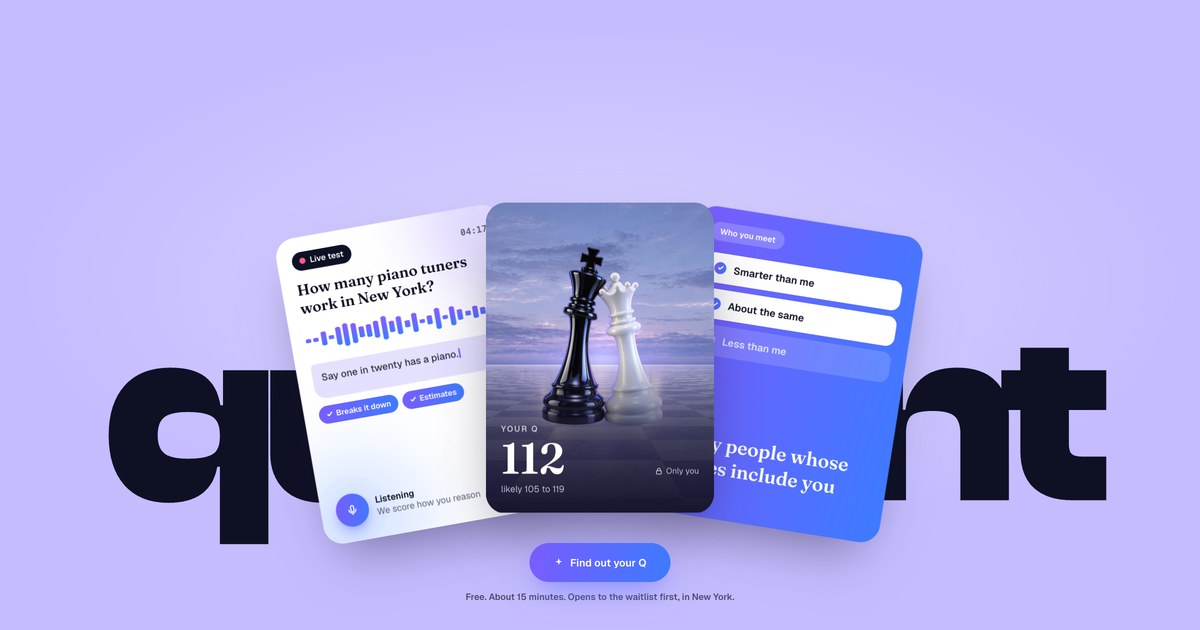
Quotient is a dating app that matches people by IQ. A free fifteen-minute conversation with an AI host estimates your IQ from how you reason. Then you choose who you meet: smarter than you, about the same, or less.
- Status
- Waitlist open
- First city
- New York
- Price
- Test and score free
- Website
- quotient.love
How the test works
You talk with an AI host out loud, or type if you'd rather. There is no multiple choice: a puzzle, a mystery, a guess at a number nobody knows, like how many piano tuners work in New York. The test listens to how you get to an answer, not only whether you get there.
Every test is different, so looking things up doesn't help. The result is an estimate built for matching, always shown with a range, such as 112, likely 105 to 119. Before launch it is calibrated against a validated public research test. It is not a clinical or diagnostic test.
The test opens to the waitlist first, in line order. Every friend who joins with your link moves you up 25 spots.
How matching works
Each person checks any of three private boxes: smarter than me (more than 7 points above), about the same (within 7 points), or less than me (more than 7 points below). You only see people who fit your boxes and whose boxes include you too.
Quotient is open to everyone at every score. It is not a high-IQ club. It matches people on how they think.
Nobody sees your number
Your score and the boxes you check are never shown on your profile, never shown to matches or friends, and the app never says why two people matched. You can delete your score at any time.
The science
Spouses' IQs correlate about 0.4, roughly twice as strongly as they match on height and weight.
Plomin & Deary, Molecular Psychiatry, 2015
Of the variation in IQ at age 17 is explained by genetic differences, up from 41% at age 9, across about 11,000 twin pairs.
Haworth et al., Molecular Psychiatry, 2010
Family studies reviewed in Science found parents' and children's IQs correlate about 0.4.
Bouchard & McGue, Science, 1981
These figures describe populations, not any one family. Genes and upbringing both matter, and children's scores tend to land closer to the average than their parents'.
Contact
Press and interviews: press@quotient.love
Everything else: hello@quotient.love
Logos and art
 Logo, PNG2587 × 680, transparent
 Logo in white, PNG2587 × 680, transparent
 Mark, PNG1024 × 1024, transparent
 Hero art, JPG1200 × 630
Also: mark as SVG and full-size hero art (5120 px). Please don't stretch, recolor or redraw the logo.